
How to Stay Consistent With Muay Thai Training: The Fighter’s Mindset
There are days when you can’t wait to train.
Your gear is packed and the BFAST shorts are on. You get into the gym feeling sharp and everything seems to click.
Then there are the other days.
You’re tired. Your body is sore. It’s freezing outside. The last thing you feel like doing is putting your gloves on and getting kicked for an hour.
Those days matter too.
If you’re wondering how to stay consistent with Muay Thai training, the answer isn’t finding a way to stay motivated every day.
You won’t.
The real skill is learning how to keep training when the motivation isn’t there.
Motivation Gets You Started. Routine and Discipline Keeps You Training.
Almost everyone is motivated when they first start Muay Thai.
Everything is new.
You’re learning how to kick. You’re hitting pads. You’re buying your first pair of BFAST shorts. You might even be imagining yourself fighting one day.
Then training becomes normal.
Progress slows down. Sessions get harder. You realise just how much there is to learn. How much it actually takes to reach a high level.
This is where consistency starts to matter more than motivation.
If you only train when you feel motivated, your training will always be inconsistent.
Instead, make training part of your week.
If you train Monday, Wednesday and Friday, those are your training days.
You don’t need to spend the afternoon deciding whether you feel like going.
You go. No ifs or buts. Don’t fight with yourself, just go.
1. Stop Waiting to Feel Motivated
One of the biggest misconceptions me and Garrett hear about disciplined people is that they always want to do the work.
They don’t. Fighters are humans too.
Experienced fighters have days when they’d rather stay at home too, with their families or go for a coffee or food with their friends.
The difference is that training has become part of their routine.
You don’t need to feel fired up before every session.
Some of your most important sessions will start with you not wanting to be there.
Get to the gym.
Get your BFAST shorts on (everything will feel better from here on in – joke*)
Start to warm-up.
See how you feel after that.
Quite often, getting through the gym door is the hardest part.
2. Give Yourself a Realistic Training Schedule
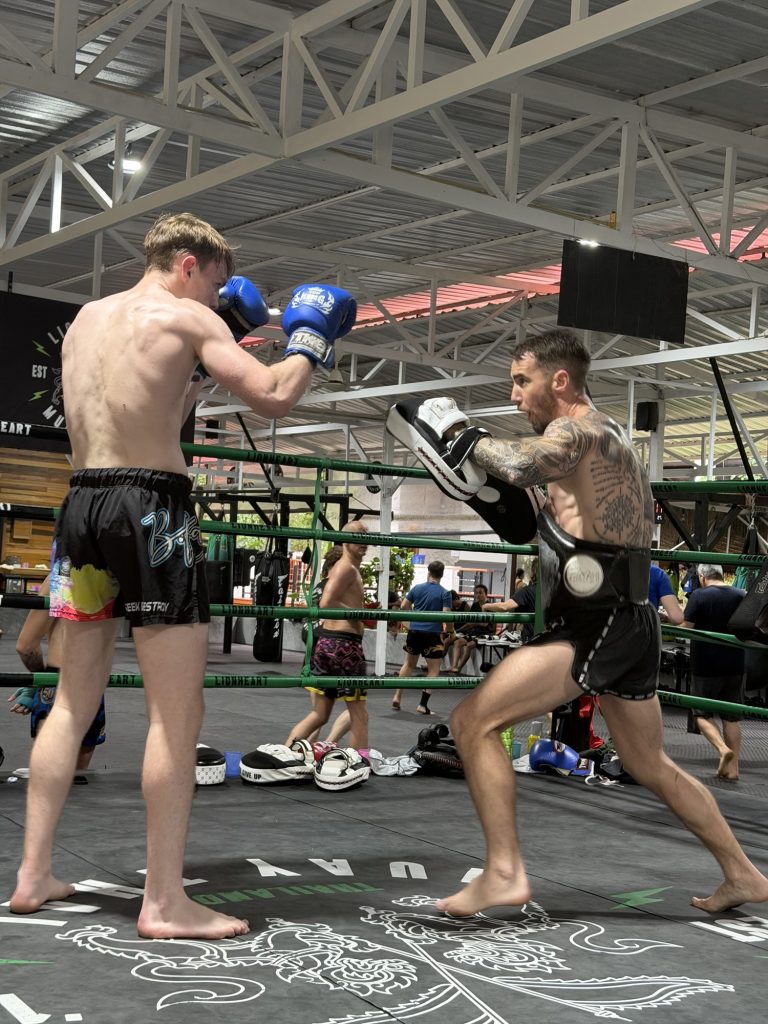
Consistency doesn’t mean training every day.
If you’ve decided you’re suddenly going to train six days a week when you’re currently managing two, there’s a good chance that routine won’t last.
Start with something you can actually maintain.
Work smart and hard.
Three quality sessions every week for six months will do far more for your Muay Thai than training every day for two weeks and then disappearing.
Your schedule also has to work around your life.
Most people aren’t professional fighters and they won’t be. That’s okay. You don’t need to train like one.
They have jobs, families, studies and other responsibilities.
Build Muay Thai into your life rather than creating a training schedule that’s impossible to maintain.
Consistency has to be sustainable.
3. Accept That Some Sessions Will Be Bad
Every fighter has bad sessions.
You’ll feel slow.
Your timing will be off.
Someone you normally handle in sparring will catch you with everything.
Your coach might correct something you thought you’d already figured out.
That’s normal.
A bad training session doesn’t mean you’re getting worse.
There’s days Garrett will get the better of me and me him. That’s completely normal.
Progress in combat sports isn’t linear.
Sometimes you’ll leave the gym feeling like you’ve improved massively.
Other times you’ll leave wondering whether you’ve ever thrown a punch before.
Both are part of training.
Don’t judge your progress based on one night.
Judge it over months, years and most importantly your results! (If you are a fighter)
4. Don’t Compare Your Chapter One to Someone Else’s Chapter Ten
Muay Thai gyms can be humbling places.
You might start training beside someone who looks effortless on the pads.
Their kicks are faster. Their balance is better. Their technique looks cleaner.
What you don’t see is the thousands of rounds that came before that.
Maybe they’ve been training for eight years.
Maybe they’ve had 30 fights.
Maybe they spent months training twice a day in Thailand.
Comparing yourself to them after six months doesn’t make sense.
Learn from better fighters.
Watch them.
Ask questions.
Train with them.
But measure your progress against the fighter you were six months ago.
Not the person standing beside you.
5. Learn to Enjoy Being Bad at Something
This is harder than it sounds.
Most adults don’t regularly put themselves in situations where they’re obviously inexperienced.
Combat sports force you to.
You will get things wrong.
You will miss pads – sorry to any of my pad holders.
You will lose your balance.
You’ll get swept.
You’ll get caught in sparring.
Someone smaller than you might completely outclass you.
Good.
That’s where the learning happens.
If your ego needs you to look good all the time, combat sports will be difficult.
The fighter mindset isn’t believing you’re brilliant.
It’s being comfortable enough with being bad at something to keep working until you’re better.
6. Have a Reason for Training
You don’t necessarily need to want to fight.
Your reason could be competition.
It could be getting fitter.
It could be learning a skill.
It could be confidence.
It could simply be that you love Muay Thai and enjoy being around the gym.
But knowing why you train helps when motivation drops.
For fighters, that reason becomes very clear when a fight is booked.
There’s a date.
There’s an opponent.
There are rounds waiting for you whether you’ve prepared properly or not.
For everyone else, you sometimes have to create your own target.
That could mean committing to three sessions each week.
Improving your boxing.
Getting better in the clinch.
Doing your first interclub.
Training consistently for an entire year.
Give yourself something to work towards.
7. Understand That Discipline Doesn’t Mean Ignoring Your Body
There’s a difference between not feeling motivated and genuinely needing recovery.
Learning that difference matters.
Recovery is a skill that needs practiced just like Muay Thai.
If you’re just tired after work and don’t fancy training, getting yourself into the gym might be exactly what you need.
If you’re injured, ill or completely exhausted from weeks of hard training, forcing another hard session isn’t automatically discipline.
Recovery is part of training.
Fighters need rest too.
Being mentally tough doesn’t mean making stupid decisions with your body.
The goal isn’t to prove how much punishment you can take.
The goal is to keep improving.

8. Stay Close to the Gym
The people around you make consistency easier.
That’s one of the best things about a good fight gym.
You train together.
You suffer through hard sessions together.
You see people preparing for fights.
You watch beginners improve.
Someone has a bad night and comes back the next day.
That environment changes how you think about training.
When the people around you take training seriously, showing up becomes normal.
That’s why gym culture matters so much in combat sports.
You’re still responsible for doing the work.
But it’s easier to do difficult things when you’re surrounded by other people doing them too.
9. Stop Expecting Progress to Feel Exciting
Some stages of Muay Thai development are exciting.
Learning your first combinations is exciting.
Your first spar is exciting.
Your first interclub or fight is definitely exciting.
But improvement is mostly repetition.
Jab.
Again.
Kick.
Again.
Check.
Again.
Pads.
Bag.
Sparring.
Clinch.
Then come back and do it again.
There’s no secret session that suddenly makes you good at Muay Thai.
Skill is built through thousands of small repetitions.
Eventually something that once required complete concentration becomes automatic.
Then you move onto the next thing.
That’s the process.
10. Remember That You Don’t Need a Perfect Week
You planned to train four times.
Life got in the way and you trained twice.
That’s still two sessions.
Don’t fall into the trap of thinking you’ve ruined the week and might as well start again on Monday.
Training isn’t a diet you restart every seven days.
If you miss Monday, train Tuesday.
If you have a terrible week, come back the next one.
If you’ve been away from the gym for a month, walk back through the door.
Consistency isn’t never missing a session.
It’s always coming back.
The Fighter Mindset Isn’t About Feeling Fearless
Combat sports sometimes get presented as if mental toughness means never being nervous, tired or doubtful.
That’s not reality.
Fighters get nervous.
They question themselves.
They have terrible sessions.
They lose fights.
They get injured.
They struggle with motivation.
Mental toughness is what happens next.
Can you learn from the bad session?
Can you return after the loss?
Can you keep working when progress feels slow?
Can you stay disciplined when nobody is watching?
That’s a much more useful definition of the fighter mindset.
Built in Belfast
BFAST comes from that same environment.
We’re a Belfast-born fightwear brand built by people who actually train and fight.
The mentality behind the brand isn’t about pretending every day is easy.
Muay Thai isn’t easy.
That’s part of why people fall in love with it.
You learn to get comfortable being uncomfortable. You learn that confidence comes from preparation. And you learn that improvement usually happens because you kept turning up long after the initial excitement disappeared.
It’s difficult to fake that mentality.
You build it round by round.
Frequently Asked Questions
How do I stay motivated for Muay Thai?
Don’t rely entirely on motivation. Create a realistic weekly training routine and treat your sessions as commitments. Having specific goals, training with good people and tracking your progress over several months can also help you stay consistent.
How many times a week should I train Muay Thai?
That depends on your experience, goals, recovery and schedule. For many recreational trainees, two to four consistent sessions per week can provide meaningful progress. Competitive fighters may train considerably more, particularly during fight camp.
Why do I feel like I’m getting worse at Muay Thai?
Progress isn’t always obvious. As your understanding improves, you may become more aware of mistakes you didn’t previously notice. Harder sparring partners, fatigue and changes in training can also make individual sessions feel worse even while you’re improving overall.
Is it normal to lose motivation for Muay Thai?
Yes. Motivation naturally changes over time, particularly once the excitement of starting something new disappears. Building a sustainable training routine is more reliable than expecting yourself to feel motivated before every session.
Should I train Muay Thai when I’m tired?
It depends on why you’re tired. General lack of motivation or a long day doesn’t necessarily mean you need to skip training. But illness, injury or accumulated physical exhaustion may require recovery. Learning to recognise the difference is part of training intelligently.
How do fighters become mentally tough?
Mental toughness develops through experience rather than motivational quotes. Consistent training, difficult rounds, competition, setbacks, losses and continuing to work when progress is slow all help develop resilience over time.
What should I do after a bad Muay Thai session?
Look at what went wrong without turning one session into a judgement of your overall ability. Take useful feedback, recover and return to training. One poor session matters far less than what you do over the following weeks and months.
Keep Showing Up
You don’t need to feel unstoppable every time you walk into the gym.
You don’t need the perfect training programme.
And you definitely don’t need another motivational video telling you to wake up at 4am.
You need consistency.
Train when you’re sharp.
Train when you’re frustrated.
Learn from the good rounds and the bad ones.
Rest when you genuinely need to.
Then come back.
Because after enough years in combat sports, one thing becomes obvious:
The people who improve aren’t always the most naturally talented. They’re usually the ones who kept showing up.
That’s a mentality we understand at BFAST.
Built in Belfast and shaped by fight culture, our gear is made for the rounds that happen when nobody is watching.
When it’s time for your next one, explore BFAST fightwear and Muay Thai shorts built for training, fighting and everything that comes with it.
BFAST — Built by fighters. Worn by fighters.